
STREAM : Seawater Treatment for CO2 Removal via Electrochemical Microelectrode Arrays
Description of the PhD project
Among negative-emission strategies, direct CO2 capture from oceans and seawater is particularly attractive because these reservoirs contain about 150 times more dissolved CO2 than the atmosphere. Several electrochemical approaches have been proposed, including bipolar membrane electrodialysis, chloride-mediated electrochemical acidification, and electrochemical hydrogen looping. The latter has demonstrated up to 91% CO2 capture efficiency with an energy consumption of 2.4 GJ per ton of captured CO2. However, many existing approaches overlook potential contamination and material integrity associated with large pH swings and long-term exposure to corrosive environments. Future developments must therefore prioritize the chemical and mechanical stability of materials under extreme pH and salinity conditions, alongside comprehensive techno-economic and life-cycle assessments of technology
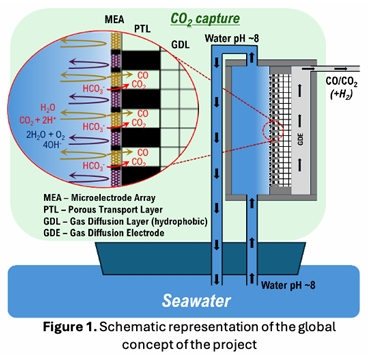
This PhD project aims to design innovative reactor architectures based on microelectrode arrays capable of generating local pH swings without the need for chemical additives or ion-exchange membranes. As illustrated in Figure 1, the system enables direct CO2 extraction from ocean or seawater, followed by either on-site storage or further electrochemical conversion into value added products. The CO2 capture relies on two key coupled electrochemical principles : (i) shifting the HCO3−/CO2 equilibrium towards CO2 through local acidification near the electrode surface, and (ii) electrochemically converting the released CO2 to CO, maintaining the bulk pH close to its initial value. This is achieved through integrated microelectrode arrays (MEAs) featuring micrometer-scale gaps between paired anodes and cathodes, as shown in the zoomed section of Figure 1, enabling strong spatial confinement of protons and hydroxide fluxes. Local acidification is driven by reaction 1, followed by pH neutralization and buffering in reactions 2 and 3. While hydrogen evolution cannot be entirely eliminated, due to proton reduction pathways, it can be minimized by selecting an appropriate catalyst, particularly with Au-based electrocatalysts known for high CO2-to-CO selectivity and suppressed H2 evolution.
2H2O => O2 + 4H+ + 4e− (oxygen evolution reaction, OER, eq. 1)
CO2 + 2H+ + 2e− => CO + H2O (CO2 reduction reaction, CO2RR, eq. 2)
2H+ + 2e− => H2 (hydrogen evolution reaction, HER, eq. 3)
The proposed approach offers several advantages over the state-of-the-art CO2 extraction
systems. First, it enables a simplified reactor design by eliminating the need for costly ion exchange membranes. Second, the process avoids excessive local pH increase, which can promote unwanted carbonate precipitation at the electrode. CO2 generated close to the anode and not valorized in step 2 at the cathode will be extracted under a small vacuum (along with CO) through the designed multilayer gas diffusion electrode (GDE, zoomed area in Fig.1), selective CO/ CO2 extraction and electronic conductivity within the MEA.
Over the course of the PhD, this concept will be translated into an integrated flow reactor that combines patterned MEAs, porous transport layers and a multilayer GDE optimized for operation in increasingly complex electrolytes, up to real seawater. The expected outcome is a reactor architecture that maintains high CO2-to-CO selectivity at low cell voltage, with limited metal leaching and stable performance over extended operation. A key objective will be to map the operating window (current density, flow rate, salinity and temperature) that maximizes CO2 extraction efficiency and energy performance, providing quantitative benchmarks for comparison with existing CO2-from-seawater technologies.
Building on this platform, the project is expected to deliver optimized MEA designs in which mass transport is actively engineered through microelectrode geometry (electrode size, gap and spacing), tailored PTL/GDL porosity and controlled flow conditions. Catalyst development will focus on robust, low- to non-precious-metal formulations (e.g. Ni-based materials, with small or no addition of Ir, or Au/Ag) synthesized by a combination of thin-film deposition (ALD, PECVD) and electrodeposition directly on porous supports, with composition and microstructure systematically varied from model electrodes to full MEAs. Performance and degradation mechanisms will be elucidated using operando AFM-based imaging, electrochemical testing and
gas/liquid product analysis, establishing clear links between catalyst design, MEA architecture and mass transport. Together, these results will provide experimentally grounded design rules and a versatile, high-impact research framework for a PhD project spanning catalyst synthesis, reactor engineering and advanced characterization.
Keywords
CO2 capture, seawater treatment, electrochemistry, electrochemical engineering
Research Unit, UMR number and acronym
ESPCI - Institute of Porous Materials of Paris, UMR 8004, IMAP
ESPCI - Institute Chemistry Biology Innovation, UMR 8231, CBI-MIE
Description of the research Unit/subunit
This PhD project will be carried out in collaboration between the Institute of Porous Materials of Paris (IMAP, UMR 8004), led by Dr. Christian Serre, and the MIE (Materials, Innovation, Energy) team of the institute Chemistry Biology Innovation (CBI, UMR 8231), led by Prof. Annie Colin.
IMAP laboratory focuses on the development and multiphysical characterization of functional
porous materials and their applications in the fields of health (drug delivery, biomaterials), energy (batteries, hydrogen, etc.), and the environment (CO₂ capture, sensing, etc.). The group’s research strongly focuses on electrocatalysis for sustainable hydrogen production, CO₂ electroreduction, and membrane-based lectrochemical energy conversion technologies. The work explores the design and optimization of advanced catalysts, such as transition metal compounds and doped materials, to enhance the hydrogen evolution reaction (HER), oxygen
evolution reaction (OER), and CO₂ reduction reaction (CO₂RR).
The MIE team of the CBI laboratory focuses on understanding the mechanisms involved in the manufacture of materials. A major part of the team’s work is dedicated to studying the behavior of complex fluids under flow, confinement and instabilities occurring during film lamination or extrusion. This expertise supports the design of advanced energy materials and devices, including electrostrictive, piezoelectric, triboelectric, battery electrode, and CO2 capture and electroreduction systems for low-power energy harvesting, storage, and conversion applications. The team also investigates the mechanisms of the reactions occurring at the electrode/electrolyte interface using a wide range of in situ and operando physicochemical characterization techniques, together with the development of devices operating under well controlled mass-transport conditions.
Name of the supervisor
Loïc ASSAUD (loic.assaud@espci.psl.eu)
Name of the co-supervisor
Alexandr OSHCHEPKOV (alexandr.oshchepkov@espci.psl.eu)
3i Aspects of the proposal
The PhD candidate will benefit from close and continuous supervision provided by both the
supervisor (Prof. Loïc Assaud, HDR) and co-supervisor (Dr. Alexandr Oshchepkov), whose complementary expertise covers electrocatalysis, electrochemical reactor engineering, materials synthesis, and advanced characterization techniques. Loïc Assaud has extensive experience in the supervision and co-supervision of PhD students, with 13 doctoral candidates supervised to date, including 4 currently ongoing. Alexandr Oshchepkov also has significant experience in student supervision, with 5 doctoral candidates co-supervised to date, including 3 currently ongoing, and collaborative research projects, ensuring complementary expertise and strong support for the successful completion of the PhD project. Regular meetings will be organized to monitor scientific progress, discuss experimental strategies, and provide guidance on data analysis, scientific communication, and career development. In addition to scientific supervision, the supervisors will support the candidate in developing transferable skills through conference participation, collaborative projects, manuscript preparation, and networking with academic and industrial partners. This strong supervisory framework will ensure both the
scientific success of the project and the professional development of the doctoral candidate. This PhD project will also establish a new collaborative research initiative between the IMAP and CBI laboratories, fostering interdisciplinary interactions and the development of complementary expertise in electrochemistry, materials science, and reactor engineering.
Intersectoriality
The project has a strong intersectoral dimension through its combination of fundamental
electrochemistry, materials engineering, and applied reactor development for sustainable carbon capture and utilization. The research addresses key technological bottlenecks relevant to industrial deployment of seawater-based CO2 capture systems, including catalyst durability, membrane-free reactor architectures, corrosion resistance, energy efficiency, and scalable manufacturing approaches. The project also presents significant innovation potential by proposing a new class of microelectrode-array-based reactors capable of locally controlling pH gradients without chemical additives or ion-exchange membranes. This approach could substantially reduce system complexity, operational costs, and environmental impact compared with current state-of-the-art technologies. The multidisciplinary nature of the work, spanning catalyst synthesis, advanced characterization, microfabrication, electrochemical engineering, and techno-economic considerations, provides strong opportunities for collaboration with industrial and non-academic partners active in carbon capture, electrolysis, water treatment, and sustainable energy technologies. The project builds upon the ongoing collaboration between the CBI-MIE team and TotalEnergies, currently focused on the development of advanced
electrode materials and reactor designs for selective CO2 electroreduction. The proposed extension toward direct CO2 capture and conversion from seawater could represent a promising direction of interest for future developments.
International
The project has a strong international dimension through its alignment with global research
efforts dedicated to carbon-neutral technologies, seawater-based CO2 capture, and electrochemical energy conversion. The scientific challenges addressed in the project are of worldwide relevance and connect to rapidly growing international research communities working on carbon capture and utilization, electrochemical reactor engineering, and sustainable fuels. The project is expected to foster international collaborations through exchanges with leading academic and research institutions specialized in electrocatalysis, operando characterization, microfabrication, and CO2 electroreduction technologies. We envision two short research stays
in partner laboratories, including visits to : (i) the group of Prof. Ulrike Krewer at Karlsruhe Institute of Technology (KIT, Germany), specializing in kinetic modelling and the analysis of complex electrode behavior under varying local pH conditions, particularly for CO2 electroreduction ; and (ii) the group of Prof. Emiliana Fabbri at Paul Scherrer Institute (PSI, Switzerland), recognized for expertise in operando spectroelectrochemical techniques, including X-ray photoelectron spectroscopy, X-ray absorption spectroscopy, Raman spectroscopy, and FTIR spectroscopy. In addition, participation in international conferences, collaborative workshops, and research networks will further strengthen the candidate’s integration into the international scientific
community.
Interdisciplinarity
The project is strongly interdisciplinary and integrates concepts and methodologies from
electrochemistry, materials science, chemical engineering, physics, and microfabrication. It combines catalyst design and surface chemistry for CO2 electroreduction with transport phenomena, interfacial physics, and fluid dynamics governing local pH control and mass transport within microstructured reactors. The work also involves advanced materials processing and characterization techniques, including thin-film deposition, electrodeposition, operando electrochemical analysis, and nanoscale imaging. In parallel, reactor engineering aspects such as porous transport layers, gas diffusion electrodes, and flow management are central to the project. Finally, the project includes techno-economic and sustainability considerations relevant to environmental engineering and carbon management technologies. This broad integration of disciplines is essential for developing efficient and scalable seawater-based CO2 capture and conversion systems.
Expected profile of the candidate
We are looking for a highly motivated, rigorous and enthusiastic PhD candidate with an excellent academic track record in physical chemistry, electrochemistry, chemical/energy engineering or materials chemistry. The project sits at the interface of electrochemistry, catalyst development and reactor engineering, so strong interest in interdisciplinary research from mechanisms to devices is essential.
A solid understanding of electrochemical concepts (kinetics, mass transport, electrode processes), basic fluid dynamics, and hands-on experience in experimental electrochemistry are desired. Experience with CAD tools for cell/reactor design (e.g. Autodesk Fusion 360) and programming skills (e.g. Python) would be a strong advantage. The candidate should be fluent in English and able to work independently and collaboratively, with good organizational and communication skills.
Important dates
Call for applications : from September 1st to October 31st 2026
Eligibility check results : November
3i Committee evaluation results : December
Interviews from the shortlisted candidates with the Selection Committee : January 2027
Start of the PhD : March 1st 2027
Euraxess job offer : https://euraxess.ec.europa.eu/jobs/462098