
PlasticPhase : Micro- and Nanoplastics as Modulators of Phase Separation and Protein Aggregation
Description of the PhD project
Micro- and nanoplastics (MNPs) are tiny plastic particles originating from the breakdown of larger plastic waste. Due to increasing water and soil pollution, they are ubiquitous in the environment, raising concerns about their impact on human health. They can interact with biomolecular condensates which are subcellular compartments confining proteins and nucleic acids organizing cellular biochemistry in space and time. Condensate formation is often mediated through multivalent interactions between biomolecules leading to liquid-liquid phase separation (LLPS). Recent studies hypothesized that LLPS-derived condensates might represent intermediates in the path yielding toxic protein aggregates present in neurodegenerative diseases.
This project aims at investigating how MNPs interacts with biocondensates. The central hypothesis is that MNPs affect intracellular phase behavior via two interconnected mechanisms : (i) direct physicochemical interactions, where particles serve as heterogeneous nucleation sites or modify intermolecular interactions, and (ii) indirect effects mediated by stress-response pathways and proteostasis imbalance. These perturbations may drive biomolecular condensates from dynamic, reversible liquid states toward persistent, solid-like assemblies associated with pathological aggregation.
Capitalizing AIV team’sexpertise, we will construct model condensates that assemble through LLPS using engineered protein scaffolds, such as multivalent protein domain prone to homodimerize. These synthetic systems mimic the properties of natural condensates, including nucleation, growth, and fusion, allowing for controlled observation in both test tubes and living cells. Additionally, the project will examine UBQLN2, a disease-relevant protein that forms condensates transitioning into stress granules under oxidative or proteotoxic stress, serving as a model for pathological aggregation.
In parallel, we will generate a tunable library of MNPs with controlled size, charge, and urface chemistry to systematically investigate their effects on phase separation. Polystyrene nanoparticles of different sizes will serve as model MNPs. These particles can be modified by PEGylation, enabling control over surface interactions and colloidal stability. In addition, particles based on other polymers (e.g., PMMA, PE, PLA,…) will be prepared using nanoprecipitation, a technique mastered at AIV, to represent the diversity of MNPs in the environment.
This library will be tested against the synthetic condensates to quantify how specific MNP characteristics influence nucleation rates, growth dynamics, and condensate properties using advanced biophysical techniques. In vitro, researchers will monitor real-time nucleation and coarsening to determine if MNPs lower energy barriers for phase separation. In cellulo, live-cell imaging and Fluorescence Recovery After Photobleaching (FRAP) will measure molecular exchange rates and viscosity, assessing whether MNPs trap condensates in a solid state. Microrheology will further characterize the viscoelastic changes in the cytoplasm induced by particle exposure.
By comparing in vitro results, where cellular stress pathways are absent, with cellular data, the study seeks to disentangle direct physical effects from indirect stress responses.
Ultimately, this research aims to provide a predictive framework for understanding how environmental plastics contribute to neurodegenerative pathology. By identifying key determinants of MNP-condensate interactions, the project could reveal new risk factors for diseases like ALS and Alzheimer’s, highlighting the urgent need to understand the molecular consequences of plastic pollution on human health.
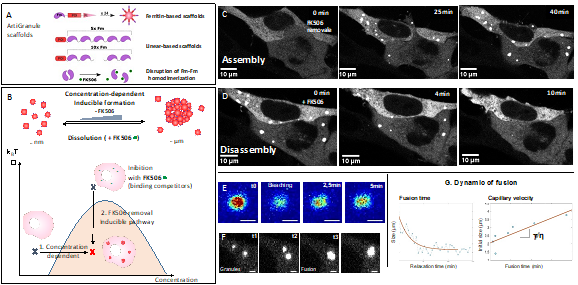
Figure 1. Artificial Condensates in the cytoplasm of HeLa cells recapitulate the hallmarks of phase-separated membrane-les compartments. A. Example of ArtiGranule scaffolds used in our project (POI = Protein of interest). B. General principle of ArtiGranule assembly/disassembly in a concentration-dependent manner1 and upon addition of a chemical stimuli. C-D. Time-lapse assembly of ArtiGranule assembly/disassembly. E. FRAP experiments show dynamic turn-over of components. F. Fusion of ArtiGranule condensates reveal a liquid-like behaviour. G. The dynamics of relaxation after fusion can be used to extract the apparent viscosity, which is about 103 Pa.s.
References
L. Sixdenier, A. Augé, Y. Zhao, E. Marie, C. Tribet, ACS Macro Lett. 2022, 11, 5, 651–656.
L. Piroska, A. Fenyi, S.Thomas, M-A. Plamont, V. Redeker, R.Melki, Z. Gueroui Z Science Adv. 2023, 9, eadg5663.
H. Merceron, … E. Marie-Bègue, L. Thouin, and L. Jullien, Adv. Sci. 2025, 12, e10903
Keywords
Micro-nanoplastics ; Biomolecular condensates ; phase separation ; protein aggregation
Research Unit, UMR number and acronym
ENS - Physical Chemistry and Chemistry of Life (CPCV) UMR 8228
Description of the research Unit/subunit
To address the project, the consortium combines expertise in synthetic biology, polymer chemistry, and biophysics to employ a multiscale approach, bridging in vitro reconstitution with cellular models. AIV Team (CPCV) : E. MARIE has extensive experience in polymer and colloidal sciences (particle formulation, surface modification) and in the physical chemistry of responsive polymers. Z.Gueroui pioneered in studying phase separation using synthetic biology and has strong experience in investigating stress-response-driven LLPS, particularly in the context of pathological condensates and aggregation (TDP-43 and alpha-synuclein) and RNA-protein condensates (stress-granules and p-bodies).
QPC team (Curie) : D.Cuvelier has a long-standing experience in developing novel tools to study biological systems, cell biophysics, combining soft matter and quantitative physical chemistry. In particular, GEMS has been already introduced in the lab to study the microenvironment of the cytoplasm and nucleoplasm under cell confinement.
Name of the supervisor
Emmanuelle MARIE (emmanuelle.marie@ens.psl.eu)
Zoher Gueroui (zoher.gueroui@ens.psl.eu)
Name of the co-supervisor
Damien Cuvelier (Damien.Cuvelier@curie.fr)
3i Aspects of the proposal
Intersectoriality
Z.G (AIV Team) has a collaboration with Sanofi on the topic of phase separation of proteins involved in neurodegenerative diseases (IDEA Tech awards Sanofi-PSL, 2022). With PSL Valo, we have a submitted a patent “Cell model of TDP-43 proteinopathy” (Europe, n°25306208.7) in 2025.
International
In the field of phase separation, we have several international collaborations that could be relevant for the PhD project. For instance, Z.G (AIV Team) start collaborating with Cláudio M. Gomes, at the University of Lisboa (Portugal), that has strong expertise in protein aggregation biophysics, proteostasis, and amyloid systems.
Interdisciplinarity
Our work brings together experts in in chemistry (polymeric nano/micro-particles), physics/biophysics (soft matter, phase transition), and biology (protein biochemistry), which is essential for studying how environmental pollutants interact with fundamental biological processes.
Expected profile of the candidate
We are looking for a highly motivated and intellectually curious candidate with a strong background in soft matter and a deep interest in biological systems. The candidate should be trained in the
theoretical and experimental foundations of complex fluids, colloids, to understand the physical principles governing out-of-equilibrium and mesoscale systems. She/he should be motivated to explore the application of physical concepts and methods to biological questions.
We are looking for someone with a genuine interdisciplinary mindset, combining quantitative rigor with a strong willingness to engage with biological complexity. She/he should be enthusiastic about learning new experimental approaches relevant to biophysics and comfortable working at the interface between physics and biology. Their profile is characterized by scientific curiosity, adaptability, and a strong motivation to contribute to collaborative, cross-disciplinary research environments.
Important dates
Call for applications : from September 1st to October 31st 2026
Eligibility check results : November
3i Committee evaluation results : December
Interviews from the shortlisted candidates with the Selection Committee : January 2027
Start of the PhD : March 1st 2027
Euraxess job offer : https://euraxess.ec.europa.eu/jobs/462072